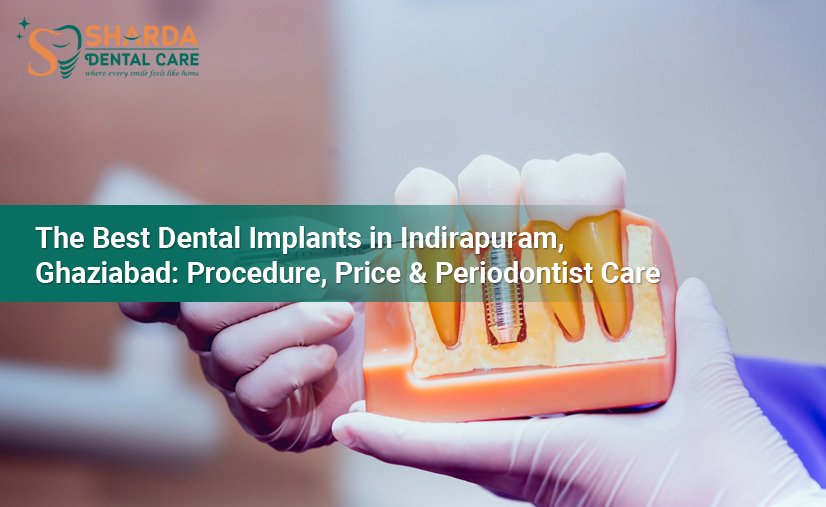
Most patients walk into an implant consultation worried about pain. They should be more worried about the dentist.
A dental implant is a small piece of titanium. Done well, it lasts 20 to 25 years and feels like your own tooth. Done in a hurry, by someone who placed their first implant last month, on a jaw that wasn’t ready for it, you’ll be back in the chair within two years, paying again.
Implants don’t really fail. The decisions around them fail.
If you’re researching dental implants in Indirapuram or anywhere in Ghaziabad, here’s what actually matters: the procedure broken down honestly, the cost ranges you’ll see across NCR, what a good oral implantologist in Ghaziabad does differently, and the questions that filter out the clinics that shouldn’t be touching your jaw.
What is a dental implant?
A dental implant is a titanium screw placed into your jawbone to replace the root of a missing tooth. After it fuses with the bone over a few months, a custom crown is fixed on top. The result looks, feels, and chews like a natural tooth, and it doesn’t decay.
Done by an experienced implantologist with proper diagnostics and a healthy periodontal foundation, the long-term success rate sits in the 95 to 98 percent range across published studies. Done without those things, it drops sharply, and you won’t know until something hurts.
Why most implants fail (and what changes the outcome)
This is the part most clinics don’t talk about because it’s uncomfortable.
Implant failure has very little to do with the brand of titanium used. It has almost everything to do with three things the surgeon controls:
- Whether your gums and bone were treated and stabilised before the implant went in. Active gum disease around an implant means slow bone loss starting on day one.
- Whether the implant was placed in the right position, at the right angle, at the right depth. Off by two millimetres and the crown will never sit right.
- Whether the surgeon has done enough of these to recognise the small signs that something will fail before it does. There’s a difference between a dentist who has placed 50 implants and one who has placed 1,500.
This is why a serious implant consultation always starts with a periodontal exam. If a clinic books you for surgery without first checking the health of your gums and the density of your bone, that’s a red flag. Walk.
The dental implant procedure: what actually happens
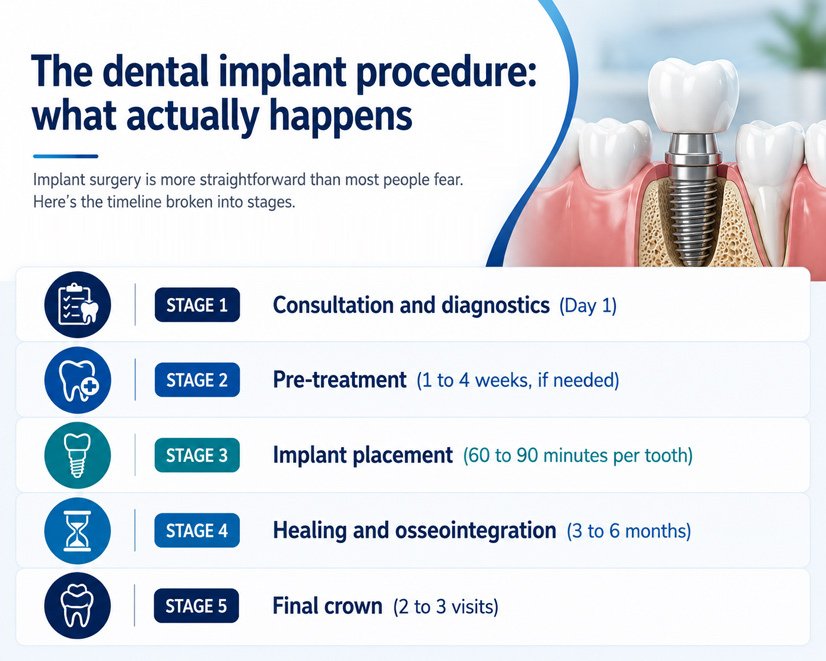
Implant surgery is more straightforward than most people fear. Here’s the timeline broken into stages.
Stage 1: Consultation and diagnostics (Day 1)
You’ll have a clinical exam, a 3D CBCT scan (not a flat OPG, which doesn’t show bone depth properly), and a periodontal assessment. The implantologist needs to see your bone volume, sinus position, nerve pathways, and gum health before recommending anything. This visit is usually 45 to 60 minutes.
Stage 2: Pre-treatment (1 to 4 weeks, if needed)
If you have active gum disease, decay near the implant site, or insufficient bone, those get treated first. Bone grafting and sinus lifts are common and add weeks to the timeline. Skipping this stage is the single biggest reason for failed implants in Ghaziabad.
Stage 3: Implant placement (60 to 90 minutes per tooth)
Under local anaesthesia, the titanium implant is placed into the prepared bone socket. You’ll feel pressure, not pain. Most patients return to work the next day. Some clinics offer same-day temporary crowns (immediate loading); whether this is right for you depends on bone quality, not just preference.
Stage 4: Healing and osseointegration (3 to 6 months)
This is the unglamorous part. The titanium needs time to fuse with your jawbone, a process called osseointegration. During this time you wear a temporary crown or denture. Healing is faster for younger patients with denser bone, slower for older patients or those with diabetes. There’s no shortcut.
Stage 5: Final crown (2 to 3 visits)
Once the implant has integrated, an impression or 3D scan is taken, a custom crown is milled to match your other teeth, and it’s fixed onto the implant. From this point on, you treat it like a normal tooth: brush twice, floss daily, dental cleaning every six months.
How much do dental implants cost in Ghaziabad?
Cost depends on three things: the implant system, the complexity of your case, and the experience of the surgeon. Here’s what you’ll typically see across reputable clinics in Ghaziabad and Indirapuram. These are indicative market ranges, not Sharda Dental‘s specific pricing.
Single implant, basic Indian or Korean system: around ₹18,000 to ₹35,000 per tooth, including the implant and crown.
Single implant, premium European or American system (Nobel Biocare, Straumann, Bredent): around ₹45,000 to ₹80,000 per tooth. The higher cost reflects 20+ years of clinical data and a longer manufacturer warranty.
Multiple implants with bridge: lower per-tooth cost when you replace adjacent teeth, since one implant can support more than one crown.
All-on-4 or All-on-6 full-arch: around ₹2 lakh to ₹5 lakh per arch, depending on the implant system and whether immediate loading is possible.
Bone grafting or sinus lift, if needed: around ₹15,000 to ₹40,000 added to the base cost.
Important caveat: a quote that seems unusually low, say under ₹15,000 for a fully fitted single implant in Ghaziabad, almost always means a generic implant, a less experienced surgeon, or a skipped diagnostic step. Implants are one of the few procedures where the cheapest option ends up most expensive over a decade.
For a written quote for your specific case, request a free implant consultation at Sharda Dental. You’ll get an honest assessment of what you actually need, including a recommendation to wait or hold off if that’s the right call.
Are painless dental implants real?
Mostly, yes. The surgery itself is done under local anaesthesia. You feel pressure and vibration, not pain. The needle for the anaesthetic is the worst part, and even that takes ten seconds.
What people actually mean when they ask about painless implants is the days after the surgery. Honestly, expect mild soreness for 2 to 4 days, swelling that peaks on day 2, and a level of discomfort similar to a tooth extraction. Standard pain medication handles it. Patients who follow post-operative care instructions, ice packs in the first 24 hours, soft food for a week, no smoking, recover faster.
Anyone advertising fully painless implants with zero recovery is either using imprecise language or hasn’t actually placed many. Recovery is real, predictable, and manageable. We’d rather you know that going in.
Dental implant recovery time: what to expect
Recovery happens on two timelines: feeling normal, and biological healing. They’re different.
You’ll feel normal within 3 to 5 days. Most patients return to work the next day with mild discomfort, eat soft food for a week, and resume regular exercise after 10 days.
The implant fuses with bone over 3 to 6 months. During this time you’ll wear a temporary tooth replacement and your normal life continues. The final crown is fitted only after the bone has fully accepted the implant.
Factors that slow healing: uncontrolled diabetes, smoking (cuts blood supply to the bone, doubles the failure rate), heavy alcohol use during the first two weeks, and skipping the antibiotic course.
Are dental implants better than dentures?
For most patients, yes. But not everyone.
Implants are fixed, feel like real teeth, preserve jawbone (dentures don’t, which is why long-term denture wearers get the ‘sunken face’ look), let you eat anything, and last 20 to 25 years. They’re a one-time investment that, amortised over a decade, often costs less than relining and replacing dentures.
Dentures are removable, less expensive upfront, and a reasonable choice if you have severe bone loss that can’t be grafted, certain medical conditions that rule out surgery, or budget constraints that make implants genuinely unaffordable.
Many of our older patients in Indirapuram come in wearing dentures they’ve had for 15 years and ask whether implants are an option. Often, yes, even after years of denture wear. The conversation worth having is which arrangement makes the most clinical and financial sense for the next 20 years, not just the next year.
How to choose a dental implant clinic in Indirapuram or Ghaziabad
Forget marketing language about world-class technology and state-of-the-art equipment. Every clinic claims these. Here’s what actually predicts a good outcome.
Ask: how many implants has the surgeon personally placed? Not the clinic. The individual surgeon. Volume matters. Aim for someone who has placed at least 500 implants over their career. More is better.
Ask: are you certified by an implant body? Look for AAID (American Academy of Implant Dentistry), ICOI, or fellowship-level Indian credentials. These require ongoing exams and case reviews.
Ask: do you do a CBCT scan before placement? If they only do an OPG (flat X-ray), they’re flying partly blind. CBCT shows bone in 3D and is non-negotiable for safe implant placement.
Ask: how do you handle gum disease before placing the implant? If the answer is We just place it, walk. Untreated periodontal disease is the leading cause of late implant failure.
Ask: what is your follow-up protocol? A good clinic schedules you back at 1 week, 1 month, 3 months, and 6 months after the crown is fitted. If they fit the crown and wave goodbye, that’s a problem.
Ask for case photos from the past year. Real before-and-afters from real local patients tell you more than any brochure.
Why patients in Indirapuram and Vaishali choose Sharda Dental Care
Dr. Sharda Bhat Sarup has personally placed 1,500+ implants over the past 25 years at our Dental clinic in Indirapuram, near Shipra Mall and the Orange County area. She’s an AAID-certified implantologist (American Academy of Implant Dentistry, 2009) and a Manipal Academy of Higher Education graduate (Class of 1998).
What that case volume means in practice:
- She has seen most of what can go wrong, and recognises early signs that flag complications before they happen.
- She knows which cases need bone grafting first, which can be done in a single visit, and which patients should be told no — and we do say no.
- Every consultation starts with a periodontal exam. Foundation first, then the implant.
- Each implant we place comes with a written 1-year, 3-year, and 5-year follow-up protocol included. No charging extra for the checks that make implants last.
We also turn down roughly one in five implant consultations at the first visit. Not because the patient can’t afford it, but because the conditions aren’t right yet. Sometimes that means treating gum disease first. Sometimes it means stopping smoking before we operate. Sometimes it means a denture is the better answer for the next two years. The implants we place are the ones that should be placed.
Patients come to us from Indirapuram, Vaishali, Vasundhara, Crossings Republik, Noida sectors 62 and 63, and as far as East Delhi. Many were referred by family members whose implants we placed five, ten, or fifteen years ago, and which are still doing their job.
Read More About : What is Teeth Tingling: Causes, Treatment & When to See a Dentist in Indirapuram
Considering implants? Start with an honest consultation.
A proper implant consultation at our clinic includes a clinical exam, a periodontal check, and a written breakdown of whether implants are right for you, with full costs and timelines. Around 45 minutes. If implants aren’t the right call right now, we’ll tell you that, and recommend what is.