Key Takeaways
- Metal braces usually cost the least and can treat almost any problem, including complex bites.
- Ceramic braces work the same way as metal ones but blend in with your teeth, and they cost more.
- Clear aligners are nearly invisible and removable, but only work if you wear them 20 to 22 hours a day.
- Braces usually take 12 to 24 months; mild aligner cases can be quicker.
- Cost depends on your case, how long treatment takes, the materials and whether retainers are included.
- Everyone needs a retainer afterwards to stop teeth moving back.
- No option is best for everyone; an orthodontic assessment decides what suits you.
You’ll be living with your braces or aligners for a year, maybe two. So the choice isn’t only about the end result. It decides what you can eat at a wedding, how long brushing takes at night and whether anyone notices in your office photos.
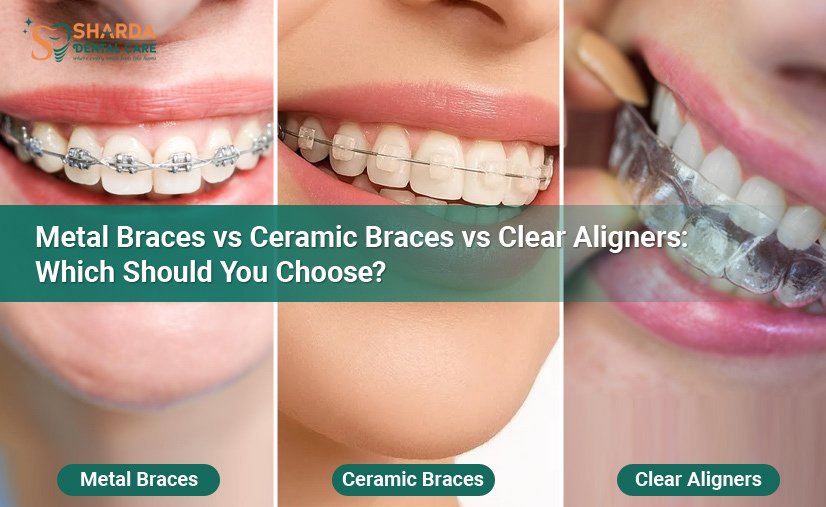
Here’s the quick answer. Metal braces are usually the cheapest and can handle almost any problem, including difficult bites. Ceramic braces do the same job with tooth-coloured brackets, so they’re harder to spot, but they cost more. Clear aligners are removable plastic trays that work well for many mild to moderate cases, as long as you wear them for 20 to 22 hours every day. Which one suits you depends on your teeth and your habits, and a proper orthodontic check is the only way to know for sure.
What Are Metal Braces?
These are the braces most of us picture. A small stainless-steel bracket is stuck to the front of each tooth, and a thin wire runs through all of them. Tiny elastic rings, or clips built into the bracket, hold the wire in place. That wire pushes gently and steadily, and over months the teeth move into line. You come back every four to eight weeks so the dentist can adjust or change the wire.
Why do so many dentists still recommend them? Because they work on nearly everything. Crowded teeth, gaps, twisted teeth, a deep overbite, an underbite: metal braces can deal with all of it. They’re fixed, so nobody has to remember to wear them. They’re tough, too, and rarely crack. And they’re normally the lowest-cost option.
The downsides are real, though. They’re the most visible choice, even if teenagers often enjoy picking coloured elastics. Your teeth will ache for a few days after fitting and after each adjustment, and the brackets can rub your cheeks until you get used to them (orthodontic wax helps a lot). You’ll need to stay away from hard and sticky foods like nuts, toffee and chewing on corn cobs. Brushing around wires simply takes longer, and a solid daily oral hygiene routine matters more than ever, because food trapped around brackets quickly turns into plaque and tartar.
They tend to suit teenagers, people with complex cases and anyone who wants a reliable result without a big bill and doesn’t mind the look.
What Are Ceramic Braces?
Think of ceramic braces as metal braces in disguise. The mechanics don’t change at all. The difference is the bracket, which is made from a tooth-coloured or see-through ceramic, often paired with a white or frosted wire. From a normal talking distance, plenty of people won’t notice them.
Because they work the same way, ceramic braces can treat most of the problems metal braces can, including many tricky ones. They’re also fixed, which takes the willpower question out of it.
There are trade-offs. Ceramic costs more. It’s also more brittle than steel, so a bracket can chip if you bite into something hard. The elastic rings can pick up stains from chai, coffee, haldi-heavy curries and tobacco, although they’re swapped at every visit. The brackets are a touch bigger, and taking them off at the end needs a little extra care.
Older teens and adults who want fixed braces but would prefer a quieter look usually find these a good middle path.
What Are Clear Aligners?
Aligners take a completely different approach. Instead of brackets and wire, you wear a series of thin, clear plastic trays made to fit your teeth exactly. Your dentist takes a scan or impressions and plans the whole movement digitally, step by step. Each tray shifts your teeth a fraction, and you move to the next set every week or two. Small tooth-coloured bumps, called attachments, are often added to a few teeth so the trays can grip and steer them.
The appeal is easy to see. They’re almost invisible. You take them out to eat, so there’s no list of banned foods, and brushing and flossing stay just as they were. There are no brackets to snap, which usually means fewer surprise trips to the clinic, and the smooth edges are kinder to your lips and cheeks.
But aligners only work when they’re in your mouth. That means 20 to 22 hours a day, every day. Take them out to eat or drink anything except plain water, brush, then put them straight back in. Leave them in a drawer and treatment slows down or stalls. Trays get lost, too, and replacements cost extra. Some complex movements and severe bite problems are still handled better with fixed braces, and aligners usually cost more than metal braces.
They’re a strong fit for adults and disciplined teenagers with mild to moderate crowding or gaps, and for people whose teeth have shifted after braces years ago.
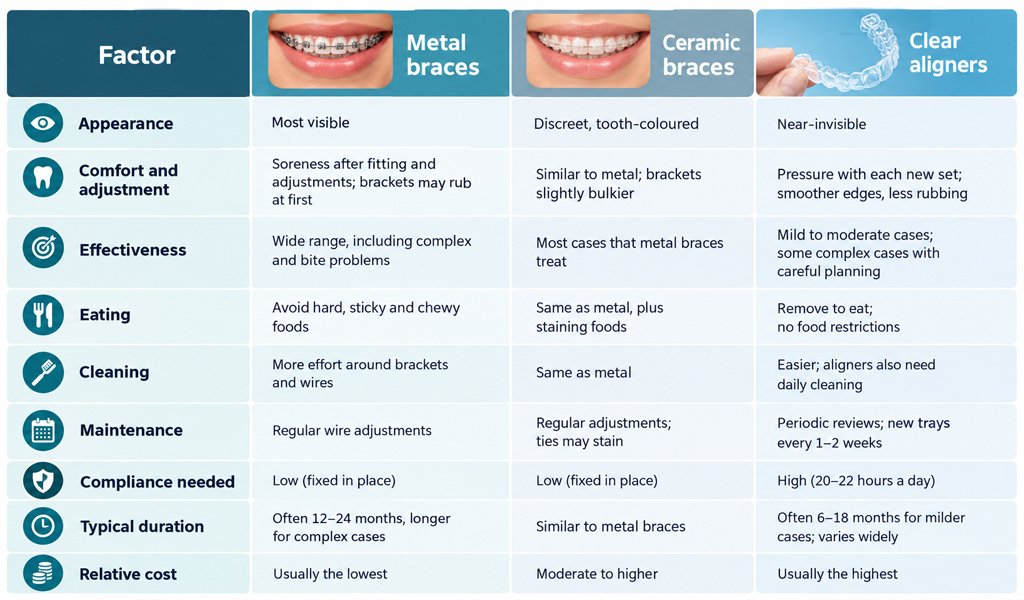
Metal Braces vs Ceramic Braces vs Clear Aligners: Comparison Table
Which Option Is Best for Different Patients?
Treat these as rough starting points. What actually decides your treatment is the examination, the X-rays and how your teeth bite together.
Teenagers
Plenty of parents choose metal braces for one simple reason: they can’t be left in a school bag. Clear aligners for teenagers do work, but only if your child will genuinely wear them. If your teen hates the metal look, ceramic braces are worth asking about.
Adults
You’re never too old for straighter teeth. Braces treatment for adults is common and works well when the gums and supporting bone are healthy. Most adults lean towards ceramic braces or aligners. Existing crowns, bridges, missing teeth or gum problems can change the plan, so mention them early. Sometimes a bit of restorative dentistry is needed before or after the teeth are straightened.
Patients prioritising appearance
Aligners are the hardest to see, with ceramic braces close behind. If your case is complicated, ceramic braces can give you a discreet look while keeping the control of a fixed appliance. Once the teeth are straight, some people also look at cosmetic dentistry in Indirapuram, such as whitening, to finish off their smile.
Patients with complex alignment or bite problems
Severe crowding, a large overbite or underbite, crossbites and badly rotated teeth are usually best treated with fixed braces, either metal or ceramic. A few cases need extra procedures or specialist input alongside them.
Patients who prefer removable treatment
Only aligners come out. If eating freely and keeping your normal cleaning routine matter a lot to you, and you trust yourself with the wear time, they’re worth considering.
Patients seeking a lower-cost option
Go for metal braces. Lower cost doesn’t mean lower quality here, as they remain one of the most effective tools orthodontics has. If budget is tight, ask the clinic about payment options.
How Much Do Braces and Clear Aligners Cost in Ghaziabad?
You won’t find one fixed price for metal braces, ceramic braces or clear aligners in Ghaziabad, and you should be careful of anyone quoting one before seeing your teeth. Broadly, metal braces cost the least, ceramic sits higher and aligners tend to be the most expensive.
The biggest factor is your case itself. Closing one small gap between the front teeth is a very different job from fixing crowding plus a bite that doesn’t meet properly. Harder cases take longer, and longer treatment means more visits and, with aligners, more trays. The brackets or aligner brand you pick changes the figure too.
Then there are the bits people forget to ask about. You might need a cleaning from our preventive dental care team, a couple of fillings or even an extraction before anything starts. And at the end you’ll need retainers, which some clinics include and some charge for separately.
So when you’re comparing quotes from different clinics in Ghaziabad, ask one thing: what’s covered from my first visit to my last retainer? A low headline number can hide a lot.
How Long Does Each Treatment Take?
Most braces treatment takes somewhere between 12 and 24 months. Complex cases can run longer. Ceramic braces follow roughly the same timeline as metal ones.
Aligners can be quicker for mild problems, often 6 to 18 months. That only holds if you wear them properly, and every skipped hour adds up.
Your timeline also depends on how far the teeth need to move, your age, the health of your gums and bone, and whether you turn up for reviews and follow instructions about elastics or trays. Once the teeth are in place, you move into the retainer phase, which we’ve covered in the FAQs below.
How to Choose the Right Orthodontic Treatment
The best way to decide is to walk into your consultation with questions. Here are the ones worth asking:
- What exactly is wrong with my teeth or bite, and how serious is it?
- Which options would work for me, and which would you pick, and why?
- How long will each option likely take?
- What does the fee include? Are reviews and retainers covered?
- How often will I need to come in?
- What happens if a bracket breaks or I lose an aligner?
- Do I need fillings, a cleaning or extractions before we start?
- What kind of retainer will I wear afterwards, and for how long?
Be honest with yourself too. If you know you’d struggle to keep aligners in all day, fixed braces will probably give you a more predictable result, and there’s nothing wrong with choosing them for that reason.
Why Seek an Orthodontic Consultation at Sharda Dental Care?
At Sharda Dental Care in Indirapuram, Ghaziabad, orthodontic treatment covers metal braces, ceramic braces and clear aligners. That matters, because it means all three can be weighed for your case instead of you being steered towards whichever one a clinic happens to offer. The clinic is led by Dr Sharda Bhat Sarup, who brings more than 25 years of experience in dentistry, and it sees families from Indirapuram, Vaishali, Vasundhara, Kaushambi and nearby.
At your consultation, your teeth, gums and bite are checked, you talk about what you’d like to change, and you’re told which options suit you, how long they’re likely to take and what they’re likely to cost. If you’re stuck between braces and aligners, book a consultation and get an answer based on your own teeth rather than something you read online, this article included.
Disclaimer
This article is for general information only and isn’t a substitute for a dental check-up. Please consult Dr Sharda Bhat Sarup or a qualified dentist before starting any orthodontic treatment.