
You bite into something cold and a bolt of pain shoots through your tooth. Or maybe it hits out of nowhere, a quick, electric jolt that stops you mid-sentence. Sharp shooting dental pain is one of those things that grabs your full attention, fast.
The good news? That sudden pain is almost always your body sending you a clear signal. Something needs attention, and catching it early usually means simpler, more comfortable treatment. At Sharda Dental Care, we see patients every week who put off that first visit because they hoped the pain would just disappear. Sometimes it does settle down on its own. But the underlying cause rarely fixes itself.
Here is a closer look at what might be behind that sharp pain, when you should be concerned, and what your dentist can actually do about it.
What Does Sharp Shooting Dental Pain Feel Like?
Not all tooth pain is the same, and the way it feels can tell your dentist a lot about the cause. Sharp shooting pain tends to be sudden, intense, and brief. It may last a fraction of a second or linger for a few minutes. Some people describe it as a zap or a jolt, almost electrical in nature.
You might notice it when you eat or drink something hot, cold, sweet, or acidic. It could hit when you bite down on food, or it might appear with no obvious trigger at all. Pay attention to when and where you feel it. Those details help your dentist narrow down the problem quickly.
Common Causes of Sharp Shooting Tooth Pain
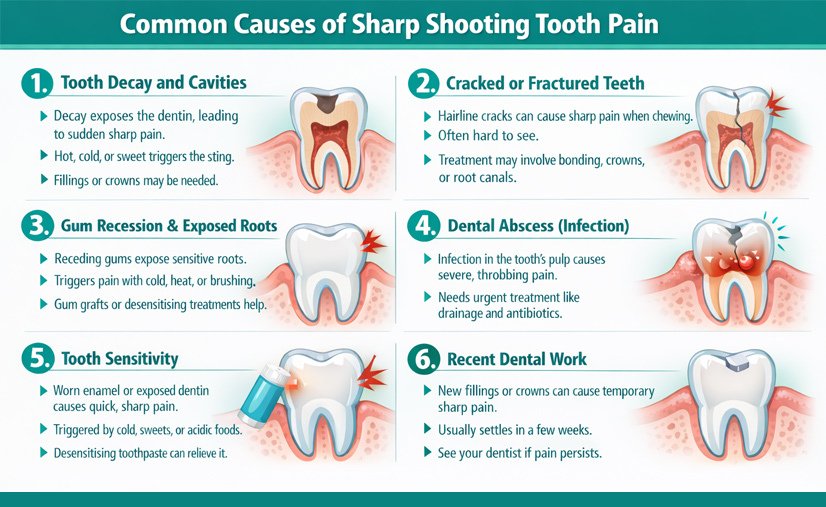
1. Tooth Decay and Cavities
Cavities are one of the most frequent reasons for sudden dental pain. When decay eats through your enamel (the hard outer layer of your tooth), it exposes the softer dentin underneath. Dentin contains thousands of tiny channels that lead directly to the tooth’s nerve. Once those channels are exposed, hot coffee, cold water, or even a breath of cold air can trigger a sharp sting.
Early cavities often cause no pain at all. By the time you feel that shooting sensation, the decay has usually progressed deeper. A dental filling or, in more advanced cases, a crown can stop the pain and protect what remains of the tooth structure.
2. Cracked or Fractured Teeth
A crack in your tooth can be surprisingly difficult to spot, even on an X-ray. Hairline fractures often cause pain that comes and goes, especially when you chew. You might feel a sharp jolt when you bite down, and then nothing for hours or days.
Cracks happen more often than people think. Grinding your teeth at night, chewing on ice, or biting into something unexpectedly hard can all cause them. The tricky part is that the pain can feel random, which makes many patients delay getting it checked. Treatment ranges from bonding and crowns to root canal therapy, depending on how deep the crack goes.
3. Gum Recession and Exposed Roots
Your tooth roots are not covered by enamel. They are protected by your gums instead. When gums recede, whether from aggressive brushing, gum disease, or simply ageing, the root surface becomes exposed. That exposed root is packed with nerve endings, and it reacts strongly to temperature changes, touch, and acidic foods.
If you have noticed your teeth looking longer than they used to, or if you feel pain near the gum line when you eat or brush, recession could be the cause. Your dentist can recommend desensitising treatments, gum grafting, or protective sealants depending on the severity.
4. Dental Abscess (Infection)
An abscess forms when bacteria reach the inner pulp of your tooth, usually through a deep cavity or a crack. The infection builds pressure inside the tooth, creating intense, throbbing pain that can feel sharp and shooting. You might also notice swelling in your gums, a bad taste in your mouth, or sensitivity to pressure.
A dental abscess will not resolve on its own, and leaving it untreated can allow the infection to spread. If you suspect an abscess, this is one situation where you should not wait. Contact your dentist as soon as possible. Treatment typically involves draining the infection, antibiotics, and often a root canal to save the tooth.
5. Tooth Sensitivity (Dentin Hypersensitivity)
Sensitivity is different from a cavity, though the pain can feel similar. With sensitivity, the enamel has worn thin or the gums have pulled back enough to expose dentin, but there may be no active decay. The pain is usually triggered by something specific, a cold drink, a sweet bite, even cold air, and fades within seconds once the trigger is removed.
Desensitising toothpaste, fluoride treatments, and dental bonding can all help. Your dentist can assess whether the sensitivity points to a deeper issue or whether targeted treatment at the surface level will be enough.
6. Recent Dental Work
Had a filling, crown, or other procedure recently? Some sensitivity and sharp twinges are normal in the days following dental treatment. Your tooth’s nerve can take time to settle down after being worked on. In most cases, this resolves within a couple of weeks.
If the pain gets worse rather than better, or if it persists beyond two to four weeks, let your dentist know. Occasionally, a bite adjustment or additional treatment is needed.
Also Read: Dental Veneers in Indirapuram: Benefits, Cost & Procedure
When Should You See a Dentist Right Away?
Some types of dental pain can wait a few days for an appointment. Others should not. Reach out to your dentist promptly if you experience any of the following:
- Severe, constant pain that does not respond to over-the-counter pain relief
- Swelling in your face, jaw, or gums
- Fever alongside tooth pain, which may signal a spreading infection
- Pain when opening your mouth wide, or difficulty swallowing
- A visible crack, chip, or broken tooth
- Pus or discharge near the painful tooth
These symptoms may indicate an infection or structural damage that needs prompt professional care. Waiting too long can turn a straightforward fix into a more involved procedure.
How Your Dentist Diagnoses the Problem
Diagnosing sharp tooth pain starts with a conversation. Your dentist will ask where the pain is, when it started, what triggers it, and how long it lasts. These details matter more than you might think.
From there, a clinical examination and digital X-rays can reveal cavities, cracks, bone loss, or signs of infection. At Sharda Dental Care, we use digital X-ray technology and precision diagnostic tools to pinpoint the source accurately, so treatment targets the actual problem rather than guessing.
In some cases, your dentist might use a cold test or a bite test to reproduce the pain in a controlled way. While that might sound unpleasant, it helps identify exactly which tooth and which nerve is involved.
Effective Treatments for Sharp Dental Pain
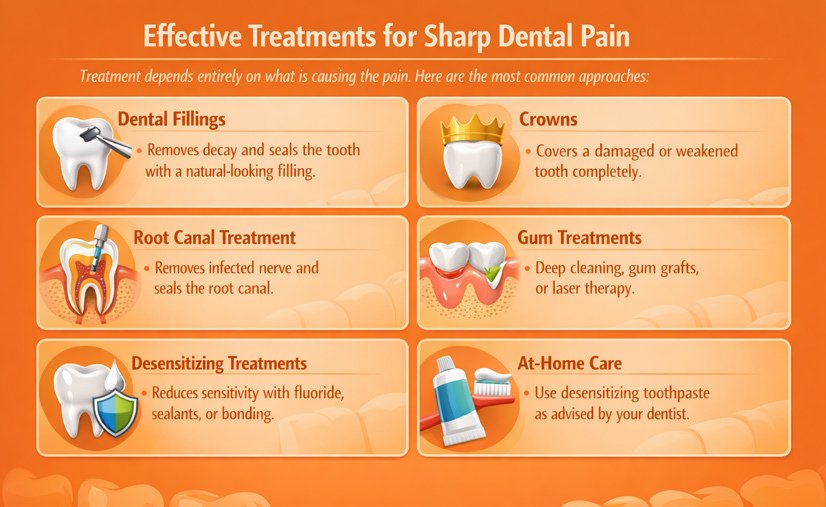
Treatment depends entirely on what is causing the pain. Here are the most common approaches:
Dental Fillings
For cavities that have not reached the nerve, a filling removes the decayed portion and seals the tooth. Modern tooth-coloured fillings blend in naturally and restore the tooth’s function.
Crowns
If a tooth is cracked, heavily decayed, or weakened, a crown covers and protects the entire visible portion. Think of it as a custom-fitted cap that holds everything together and prevents further damage.
Root Canal Treatment
When infection or damage reaches the nerve inside your tooth, a root canal removes the infected tissue, cleans the canal, and seals it. Despite its reputation, modern root canal treatment is a comfortable procedure with local anaesthesia. Most patients say it felt no different from getting a filling.
Gum Treatments
For pain caused by gum recession or gum disease, treatment may include deep cleaning (scaling and root planing), gum grafting, or laser gum therapy. These procedures address the root cause and protect the exposed surfaces.
Desensitising Treatments
Professional fluoride applications, dental sealants, and bonding agents can reduce sensitivity by blocking the tiny channels in exposed dentin. Your dentist may also recommend a desensitising toothpaste for daily use at home.
What You Can Do at Home While Waiting for Your Appointment
Home remedies will not fix the underlying cause, but they can help manage discomfort until you can see your dentist:
- Rinse gently with warm salt water (half a teaspoon of salt in a glass of warm water) to reduce inflammation
- Take an over-the-counter pain reliever like ibuprofen as directed on the packaging
- Avoid very hot, very cold, or very sweet foods and drinks that trigger the pain
- Use a soft-bristled toothbrush and brush gently around the sensitive area
- Apply a cold compress to the outside of your cheek if there is swelling
These steps can take the edge off, but they are temporary measures. The sooner you visit your dentist, the sooner you can get lasting relief.
How to Reduce Your Risk of Sharp Dental Pain
Most causes of sudden tooth pain are preventable with consistent oral care and regular dental visits. A few habits go a long way:
Brush twice a day with a fluoride toothpaste and a soft-bristled brush. Floss daily, even when your gums feel fine. If you grind your teeth at night, ask your dentist about a custom night guard. Avoid chewing on hard objects like ice, pen caps, or unpopped popcorn kernels. And perhaps most importantly, visit your dentist every six months for a check-up and cleaning. Catching small problems early is always easier and more comfortable than fixing big ones later.
Experiencing Sharp Tooth Pain? We Can Help
If you are dealing with sharp shooting dental pain, do not wait for it to get worse. At Sharda Dental Care in Indirapuram, Dr. Sharda Bhat Sarup and our experienced team will get to the bottom of what is causing your discomfort and recommend the right treatment for your situation.
With 25+ years of clinical experience, advanced diagnostic tools including digital X-rays and laser technology, and a gentle, fear-free approach, we make sure every visit is as comfortable as possible. Whether it is a simple filling or something more involved, you are in safe hands.
Book your consultation today. Call us or visit theshardadental.com to schedule your appointment at our Indirapuram clinic.
Frequently Asked Questions
Why does my tooth hurt when I drink cold water?
Cold sensitivity usually means the protective enamel on your tooth has worn down, or your gums have receded to expose the root. The cold reaches the nerve through tiny channels in the dentin. A dental check-up can determine whether you need a filling, bonding, or a desensitising treatment.
Can sharp tooth pain go away on its own?
Sometimes the pain settles temporarily, especially if it was triggered by a one-time event like biting something hard. But the cause, whether it is a cavity, crack, or early infection, typically remains. If pain returns or worsens, see your dentist rather than hoping it resolves.
Is sharp tooth pain always a sign of a cavity?
Not necessarily. Cracked teeth, gum recession, sensitivity, infections, and even sinus pressure can all cause sharp dental pain. Only a proper dental examination can determine the exact cause.
How long should I wait before seeing a dentist about tooth pain?
If the pain is mild and triggered only by specific foods, booking an appointment within the next week or two is generally fine. If you have severe constant pain, swelling, fever, or visible damage to the tooth, contact your dentist the same day.
Does root canal treatment hurt?
Modern root canal treatment is performed under local anaesthesia and is typically no more uncomfortable than getting a filling. Most patients feel immediate relief once the infected nerve tissue is removed. At Sharda Dental Care, we prioritise gentle, pain-free procedures using advanced techniques.